Stretchable Ink Printing

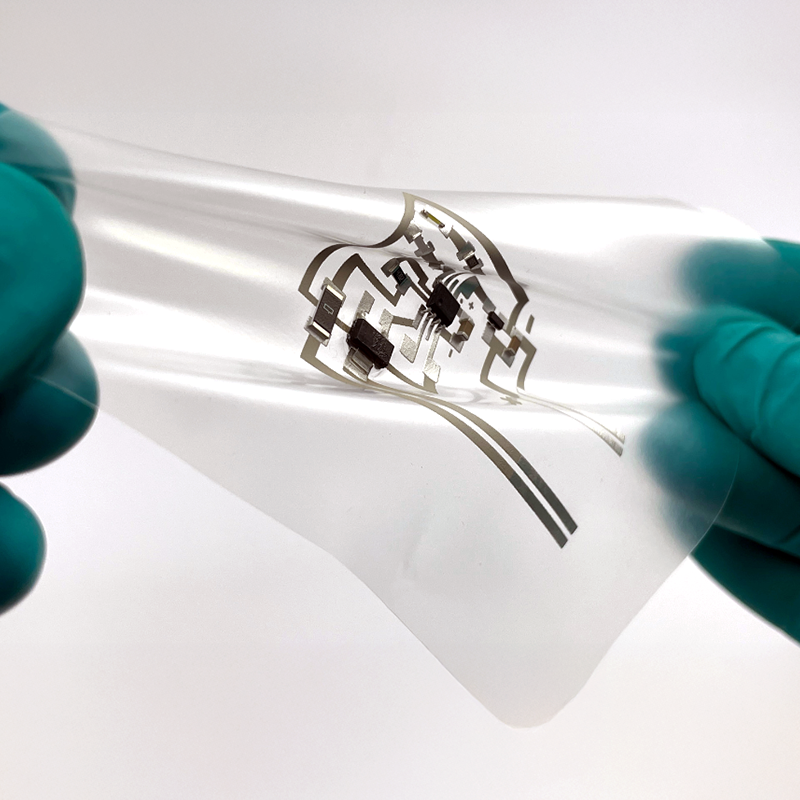
Stretchable conductive inks are formulated with conductive particles blended into elastic binders. When printed onto materials like TPU films, fabrics, or flexible polymers, the ink stretches along with the surface while maintaining electrical performance.

This technology makes it possible to integrate circuits, sensors, LEDs, and touch interfaces directly into elastic products. Because the inks can handle repeated deformation, they work well for next-generation wearable and flexible electronics.

The process supports standard screen-printing methods, making it suitable for prototyping as well as large-scale production.
Specifications

  • - Printing method: Screen printing
  • - Substrates: TPU, elastic textiles, flexible polymer films
  • - Conductive layer: Stretchable silver or carbon inks
  • - Stretchability: Typically 20–50% elongation (higher with specialized formulations)
  • - Washability: Good with proper encapsulation
  • - Operating voltage: Suitable for low-voltage electronics
  • - Layer thickness: Ultra-thin printed traces
  • - Durability: Maintains conductivity after repeated cycles of stretching
Stretchable Ink Printing
  1. - Wearable electronics and smart clothing
  2. - Flexible lighting and printed LED circuits
  3. - Medical monitoring patches and health wearables
  4. - Soft robotics and motion-sensing surfaces
  5. - Stretchable touch buttons and control panels
  6. - Interactive textiles
  7. - Sports and fitness equipment sensors
  8. - Elastic straps, bands, and sleeves with embedded circuits
  1. - Fully stretchable conductive ink
  2. - Stable electrical performance under repeated stretching
  3. - Compatible with screen-printing processes
  4. - Works on elastic films and fabrics
  5. - Withstands bending, folding, and twisting
  6. - Supports sensors, LEDs, and low-voltage components
  7. - High durability and good wash resistance on textiles
  8. - Customizable for different stretch levels
  1. - Enables electronics on elastic and form-fitting materials
  2. - Resists cracking or breaking under stretch
  3. - Lightweight and comfortable for wearables
  4. - Easy integration using standard printing methods
  5. - Supports seamless and compact product designs
  6. - Reduces reliance on rigid components
  7. - Ideal for growing flexible and soft-electronics markets

No content available for this section.